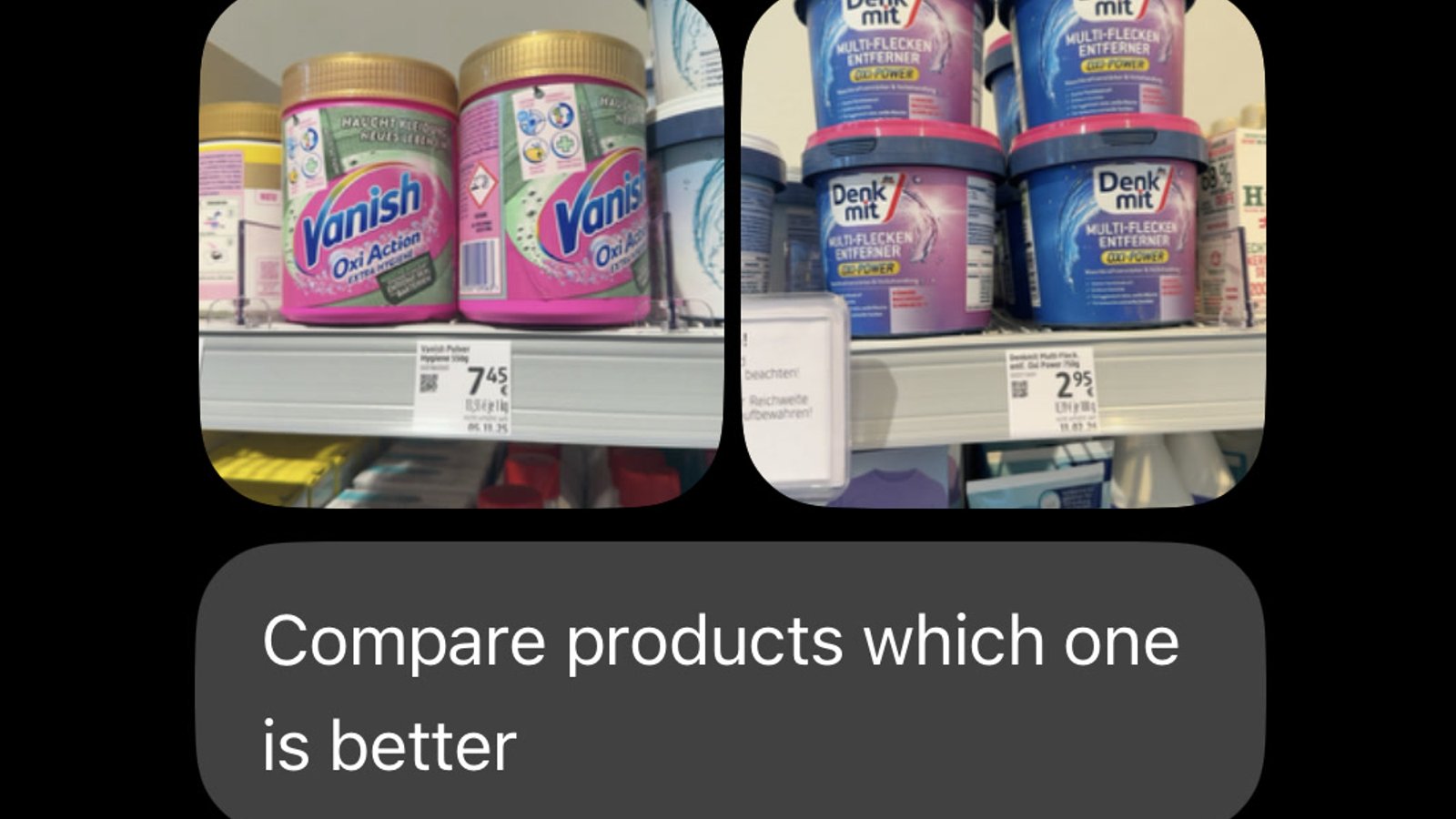
The question behind my thesis is one I keep running into while shopping. Two tubs of stain remover on the same shelf, one for €7.45 and one for €2.95. What is the difference? The labels do not answer that in a way I can use standing in the aisle. So I photographed both and asked an AI on my phone to compare them. The answer was useful. Getting it meant stopping, taking photos, typing and waiting.
The information existed. What was missing was a way to get it at the moment of choosing, with the product in front of me. That is where this work began, and its first version is worth showing, because almost everything the study does today is a reaction to it.
A smarter shop
The first version was a course project in design research, and its question was big: how could augmented reality (AR) and the Internet of Things (IoT) change shopping in a physical store? Shelves that know their stock, offers that update themselves, checkout without a queue, and a layer of information over the products. AR glasses were still niche, so the phone camera was the realistic device. I wrote one line about where it could go that I still like: "think hands-free product info while browsing store aisles."
To make it concrete I wrote two scenarios. Sam, newly gluten-free, walks through a grocery store where suitable products light up green and a tap opens a nutrition snapshot. Aisha buys a sofa at IKEA with glasses handed out at the entrance and follows an arrow to the right aisle. In the summary of that series I noted the point that later mattered more than all the features: "the importance of balancing information density so as not to overwhelm users."
Looking back, the system was the hero of every scenario. The shopper's role was to be helped.
A paper prototype for the glasses
The next course asked for a quick prototype, and I went back to the grocery store, this time on glasses. In the paper prototype, the shopping list syncs as you walk in, a cue tells you the rice is just to your right, a card shows brand, price and rating, and a comparison shows the same kind of rice at another supermarket chain. Navigation, product information and comparison, all in one assistant.
We tested it in a classroom round of speed dating, three minutes per prototype. The feedback was kind. It was also feedback from classmates on a sketch, which is a different thing from evidence.
The first build
Then I built part of it. The IKEA scenario became an app for the Meta Quest in Unity, with a guide on the headset, a simulated store backend, and QR codes to identify things. It worked in the editor and failed on the headset. The cause was a scanning package written for an older generation of Meta's XR tools, inside a project built on the newer standard. In the end I rebuilt the project on the newer foundation, and wrote down the lesson: "sometimes the most important skill is knowing when to stop patching a problem and instead take a brave step back to rebuild the foundation correctly."
I did not know yet that the same lesson would apply to the research question.
Reading someone else's thesis
For another course I reviewed Camen Teh's doctoral thesis, Augmenting Shopping Realities, from the University of Nottingham. Reading a complete study on AR shopping, from question to evaluation, showed me what a research project looks like next to a product idea. My takeaway was a single line: "give people decision & useful information, let them control the presentation a little". Control over the information came back later, from a very different direction.
From the shop to the person
When I wrote the thesis exposé, the problem moved. It was no longer what is wrong with retail. It was how AR glasses should support a person in a busy physical place like a shop. That shift, from the store to the person wearing the glasses, is the direction the work has kept ever since.
The proposal
My thesis proposal, approved by my supervisor, Michael Kernbichler, was titled "Evaluating Head-Worn AR and IoT-Based Contextual Information for In-Store Retail Shopping". It described a whole smart store on a headset: wayfinding to the shelf, product and availability information over the products, a comparison of two similar products, and a simulated checkout status, in two settings, grocery and furniture. The comparison was against a non-AR baseline, described as "standard smartphone shopping list, 2D store map, or manual search".
That last phrase names three different baselines at once.
A design brief and a thesis proposal
Feedback on the proposal made the gaps concrete. Two store types and three groups of features were a lot for one study. The IoT data would be simulated, and as I later put it myself, "calling fully hardcoded data 'IoT-like signals' does not make it IoT." The study still needed its design: how many participants, and whether each person would see every condition. And the research gap needed to be demonstrated from the literature.
I summed it up like this: "That is the difference between a design brief and a thesis proposal. I had written the former when I needed to produce the latter."
A design brief describes what to build. A thesis proposal states what will be known afterwards, and how. The next post is about how the question got there: twenty people, a lot of reading, and three things I got wrong.