Every assistant has to decide who starts. A voice assistant waits for its name. A booking site asks whether you want breakfast. Autocorrect just changes the word. My thesis compares these three ways of starting in one situation: a person in a shop, holding a product and deciding whether it fits what they need, with an assistant on a head-worn display.
The three versions
- On-demand. Nothing appears until you ask, with a small pinch.
- Offer-first. A small, silent prompt offers information. Pinch to open it, or ignore it and it goes away.
- Automatic. The information appears by itself.
An old question in a new place
The question is older than AR. Eric Horvitz (1999) described mixed-initiative interfaces, in which a system weighs the costs and benefits of doing nothing, asking the user, or acting on its own. McFarlane and Latorella (2002) described ways of coordinating an interruption, among them immediate interruption, delivered at the soonest possible moment, and negotiated interruption, where the person controls when to deal with it. In those terms, an offer is a negotiated interruption and automatic delivery is an immediate one.
Several studies have compared these starting moves directly:
- Peng and colleagues (CHI 2019) tested three levels of proactivity in a shop-assistant robot with 36 participants choosing shoes from pictures on a laptop. The most proactive level was rated the most interrupting. The robot's words also changed with each level, so what it said changed along with when it spoke.
- Kraus and colleagues (IEEE Access 2021) compared four strategies of a robot assistant in a planning task, with 42 participants, each seeing one strategy. The recommended option stayed the same in every strategy, and overall trust did not differ between them.
- Harari and Amir (CHIWORK 2026) asked people to read written scenarios of AI help at work. Help that was asked for felt less threatening than help that was offered or delivered automatically, and offering and automatic delivery did not differ significantly.
- Wang and colleagues (CHI 2026) compared a proactive and a reactive tutor on Apple Vision Pro, with 22 medical students split between the two. There was no offer step, and the messages and the input differed between the versions.
- On head-worn displays, AiGet and Sensible Agent built proactive help, without comparing the starting moves on the same content (see the previous post).
These studies compared starting moves with robots, laptops, written scenarios and a tutor on a headset, and in most of them something besides the starting move changed too. The comparison of on-demand, offer-first and automatic delivery of the same content, on one headset, while a person decides about a product in their hand, is not measured in these works. That is where this thesis works.
Why one factor
When the design took this shape I worried that it was too simple: one question, three versions. A whole assistant looks more ambitious. The earlier part of this story is the reason it is one factor. A study that changes several things at once can only show that something mattered. A study that changes one thing can show what.
So almost everything is held the same in all three versions:
- the same headset,
- the same information, shown in full at once, in the same layout, so the amount of information does not vary with the version,
- the same two pinch gestures.
What changes is who starts the help, and with it when the information appears and what the person has to do: ask, accept, or nothing. The offer also adds its own small prompt. The thesis compares the three versions as each would be built, so a difference between them belongs to the starting policy as a whole.
Comparing glasses with the phone remains a good question. It needs its own study, because a phone changes the device, the way you stand, the layout and how readable the label is, all at once. It is listed as future work.
The device and the products
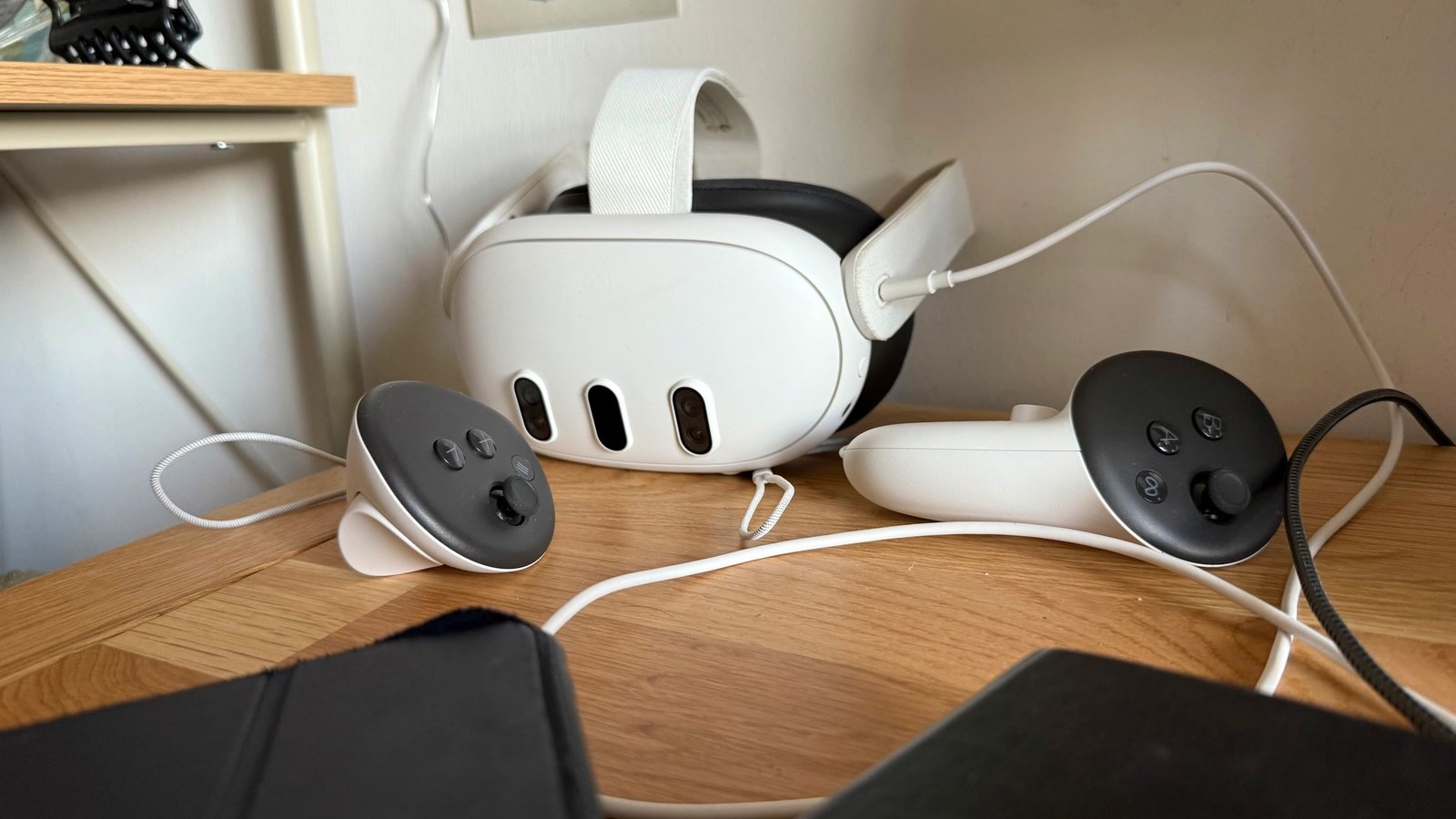
The assistant is meant for display glasses, glasses with a small screen in the lens. These are now sold to consumers: Meta Ray-Ban Display is on sale at a limited number of retailers in the US. They are not available for a study here, so the study uses a Meta Quest 3 in video passthrough as a stand-in.
Passthrough has a cost. Small print on a real package is hard to read through the headset's cameras, while the assistant's cards are sharp, which would push people towards the assistant for a reason unrelated to the policy. So the study uses cardboard mock products with packaging based on real products, printed at a size chosen by a legibility test. The thesis states the trade-off: designed print may be easier to read than real packs.
What is measured
Each participant uses all three versions, in a balanced order, at a lab shelf. The study asks how interrupted people felt and, separately, whether the information arrived when they wanted it. An interruption is not always bad: help that breaks in at the right moment can be welcome, so the two are asked separately. It also looks at perceived control, whether people chose correctly, how long they took, workload and usability, what people did with offers and requests, and what they say in an interview afterwards.
The study starts with 24 participants. It grows in groups of six, up to 36, only if the confidence intervals are still too wide to be useful. The size of the difference plays no part in that decision.
What it can and cannot say
The study is exploratory. Each comparison is reported as an estimate with a 95% confidence interval, and every planned comparison is reported. With 24 people, small differences may remain unresolved. It runs in a lab, with adults aged 18 to 29, mock products and a headset standing in for glasses. Within those limits it can show how the three ways of starting compare when everything else is held still.
The next post is about building the prototype that makes the comparison possible.